Your school name
10th Class Physics Chapter 8 Test10th Class · Physics · Federal (FBISE)
Q1. Multiple choice questions (Attempt all · 10 × 1 = 10)
- Electricity ensures our devices remain functional by:
- A thermistor is generally made from:
- Active elements in a circuit:
- In a resistor, the first two bands represent:
- Electrical hazards may be caused by:
- In carbon resistors, the resistance value is usually represented by:
- Residual-Current Devices (RCDs) detect:
- The standard voltage for household appliances is around:
- A current of 50–100 mA through the human body can cause:
- Which application of electricity is related to productivity and communication?
Q2. Short questions (Attempt any 6 of 8 · 6 × 2 = 12)
- What does an RCD (Residual-Current Device) do?
- What makes touching a live wire while barefoot on the ground particularly dangerous? How do the factors involved influence the severity of electrical shock?
- Why is a circuit called a closed loop?
- Give two examples of devices that use electric motors.
- Write the formula for equivalent resistance in parallel.
- What do the first two colour bands of a resistor represent?
- What is the function of the live wire in household wiring?
- Why are electrical devices in homes connected in parallel rather than in series? How would household functionality be impacted if they were connected in series?
Q3. Long questions (Attempt any 2 of 3 · 2 × 4 = 8)
- In the circuit shown, what is the value of the total resistance of the circuit between points A and B?
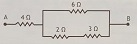
- Three resistors R₁ = 8Ω , R₂ = 12ΩR and R₃=18Ω are connected in parallel. Calculate the total resistance of the combination.
- Calculate the: (a) Power consumed (b) Current flowing through (c) Electrical energy consumed by the bulb in the given figure.
