Your school name
10th Class Physics 3rd Quarter Book Paper10th Class · Physics · Federal (FBISE)
Q1. Multiple choice questions (Attempt all · 12 × 1 = 12)
- To avoid thermal noise, qubits are cooled to within a few thousandths of a degree of:
- The usual range of ammeters for home appliances is:
- Electricity ensures our devices remain functional by:
- In an NPN transistor under normal operation, the emitter-base junction is:
- Conventional current flows:
- A thermistor is generally made from:
- Which of the following is not a basic logic gate?
- Ohm’s law is valid for:
- Active elements in a circuit:
- Materials whose electrical conductivity falls between conductors and insulators are called:
- When a battery is connected to a copper wire, the free electrons:
- In a resistor, the first two bands represent:
Q2. Short questions (Attempt any 8 of 12 · 8 × 2 = 16)
- Define electromotive force (emf).
- What does an RCD (Residual-Current Device) do?
- How do relays improve electrical systems? Give examples.
- Name two insulators with very high resistivity.
- What makes touching a live wire while barefoot on the ground particularly dangerous? How do the factors involved influence the severity of electrical shock?
- Give two uses of LEDs.
- Give two examples of emf sources.
- Why is a circuit called a closed loop?
- When collector current in a junction transistor is 99.9 mA and base current is 0.1 mA, how much is the emitter current?
- How does temperature affect the resistance of conductors?
- Give two examples of devices that use electric motors.
- How is light produced in an LED?
Q3. Long questions (Attempt any 3 of 4 · 3 × 4 = 12)
- Explain with diagrams how a transistor can be used as a switch. Describe cutoff and saturation conditions of the transistor switch.
- In the circuit shown, what is the value of the total resistance of the circuit between points A and B?
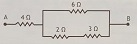
- At some temperature T₀, the resistivity of a metallic conductor is 1.7×10−⁸Ωm.If the temperature is increased by 50 K, find the new resistivity by taking temperature coefficient of resistivity as 0.004.
- In a junction transistor, emitter current is 5.82 mA and base current is 120 Aµ. Calculate the collector current.