Your school name
10th Class Biology Chapter 5 Test10th Class · Biology · Punjab (PTB)
Q1. Multiple choice questions (Attempt all · 10 × 1 = 10)
In central Nervous system (CNS) myelinated axons form:
Inside cranium, brain is covered by three layers of membranes, collectively called
Schwann cells are the supporting cells for neurons. They make:
How many neurons are present in an adult human brain?
Which of these acts as exocrine as well as endocrine gland?
If growth hormone is produced more than normal the condition is called:
Which part is responsible for sensations of temperature, hunger, thirst, and sleep?
After 8-10 hours fast the normal blood glucose level is:
Which hormone is responsible for the release of egg cells from ovary in females?
In chemical coordination, which of the following acts as a coordinator?
Q2. Short questions (Attempt any 6 of 8 · 6 × 2 = 12)
What do you know about synapse and neurotransmitter?
Differentiate medulla oblongata, cerebellum and pons on the basis of their functions
Describe shortly about forebrain.
Differentiate between the following: Cerebrum and Cerebellum
Name the three major parts of the human brain.
How brain is protected?
Identify the following diagram, and locate the white matter, grey matter, three types of neuron, and ganglia.
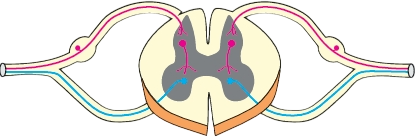
What are Schwann Cells and what is their role?
Q3. Long questions (Attempt any 2 of 3 · 2 × 4 = 8)
Describe the structure of a neuron and support your answer with a labelled diagram.
Describe the functions of pancreatic hormones.
What are the differences and similarities among the three types of neurons?