Your school name
1st Year Physics Chapter 12 Test1st Year · Physics · Punjab (PTB)
Q1. Multiple choice questions (Attempt all · 10 × 1 = 10)
The anti-particle of electron is:
Which one of the following is the fundamental particle?
Which one of the following radiation/particles has the highest ionization power?
Which type of particle naturally appears in string theory, helping it include gravity?
Which of the following particles mediates the electromagnetic forces?
The force not include in the standard model is:
Pair production is a process in which a photon is converted into:
Which of the following particles is massless?
The strong nuclear force between the two particles is mediated by:
Quarks ara holds together by which fundamental force?


Q2. Short questions (Attempt any 6 of 8 · 6 × 2 = 12)
What is the effect of beta plus decay on the nucleus?
State the role of Higgs Boson in the generation of mass in modern physics theories.
Is radioactivity affected by temperature or pressure?
Fill in the missing particle or nucleus:(a)
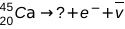 (b)

What is the weakest and strongest fundamental force?
Why does beta-decay have a continuous energy spectrum and alpha-decay have a discrete energy spectrum?
How do a proton and a neutron convert to each other?
Identify the element that has 87 nucleons and 50 neutrons.
Q3. Long questions (Attempt any 2 of 3 · 2 × 4 = 8)
Describe four fundamental forces in nature.
What is the difference between matter and anti-matter? Discuss reasons why our universe is almost entirely composed of matter.
Explain the phenomenon of pair annihilation with an example. Explain the utility of its principle in the medical field.