Your school name
2nd Year Business Statistics Full Book Paper2nd Year · Business Statistics · Punjab (PTB)
Q1. Multiple choice questions (Attempt all · 15 × 1 = 15)
A set which conatin countless elements is called:
Mid-point of class limit is also called:
The ratio obtained by dividing the price in a given year by the price in proceeding year are called:
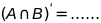
If
 then A and B are:
The empirical relationship between mean, median and mode is, made=:
A qualitative variable is called:


None of these
The graph of frequency distribution is called:
Index numbers are basically classified into:
The probability of getting head on a single throw of a coin is:


None of these
For an open and frequency distribution.It is not possible to calculate:
Uniform of a student is an example of:

Both length and width are used in:
Index number for base year period is always:




Q2. Short questions (Attempt any 12 of 18 · 12 × 2 = 24)
What does ...... denote for?
Define primary data.
Define exhaustive events.
The sum of deviation of 15 values from 20 is 45. Find Arithmetic mean.
Define quantity index number.
What is meant by universal set?
Define multiple bar chart.
Define discrete data.
What is the range of probability.
The wages of six workers in rupees are 1800,1900,1700,2200,2000 and 1600. Find mean.
Given
 then find current year a weighted index number.
Define set.
Define Historigram.
Explain the difference between population and sample.
Define dependent events.
If mode=125, mean=80 is a skewed distribution calculate medians.
Why index numbers are called economic barometers.
How many committee of 4 persons can be taken from 12 persons?
Q3. Long questions (Attempt any 4 of 6 · 4 × 9 = 36)
Make frequency distribution from the following data taking classes as: 0-1, 2-3, 4-5,-5,0,1,4,0,2,8,2,0,4,2,1,0,7,3,1,2,6,0,2,2,5,7,2,3,9,6,3,4,5,4,1,2,3,1,5
The price of wheat (per 40 kg) is given below. compute chain indicies using 1999 as base year:
Years 1999 2000 2001 2002 2003 2004 2005 Price 550 550 600 640 690 750 800 One integer is chosen at random from the numbers 51, 52, 53 ...... 100. What is the probability that the number chosen is divisible by (i) 10 (ii) 6?
Calculate A.M from the following distribution by coding method:
Groups 1.5-2.0 2.0-2.5 2.5-3.0 3.0-3.5 3.5-4.0 4.0-4.5 Frequency 3 7 10 15 9 6 Let A={1,2,3,4}, B={2,4,6,8} and C={3,4,5,6} Find:(i)
 (ii)
 (iii)
 (iv)

Make a frequency distribution taking I as class interval: 2,8,10,9,7,9,4,3,5,6,8,7,9,6,6,11,1,5,6,6,5,7