Your school name
2nd Year Business Statistics 3rd Quarter Book Paper2nd Year · Business Statistics · Punjab (PTB)
Q1. Multiple choice questions (Attempt all · 12 × 1 = 12)
A set which conatin countless elements is called:
If
 then A and B are:
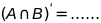


None of these
The probability of getting head on a single throw of a coin is:


None of these

The set of all possible outcomes of a random experiment is called:
An ordinary arrangement of object is called:
If
 then events A and B are:
A set, which conatins no element is called:
The probability of an event must be:
A non-ordinary arrangement of things is called:
The probability of drawing any one spade from pack of 52 cards is:




Q2. Short questions (Attempt any 8 of 12 · 8 × 2 = 16)
What is meant by universal set?
Define exhaustive events.
Define set.
What is the range of probability.
How many committee of 4 persons can be taken from 12 persons?
Define dependent events.
Differentiate between permutation and combinations.
Write a sample space for toss of fair cubical die.
Define combination.
Distinguish between sure event and impossible event.
Define infinite set.
What is trail.
Q3. Long questions (Attempt any 3 of 4 · 3 × 4 = 12)
Let A={1,2,3,4}, B={2,4,6,8} and C={3,4,5,6} Find:(i)
 (ii)
 (iii)
 (iv)

One integer is chosen at random from the numbers 51, 52, 53 ...... 100. What is the probability that the number chosen is divisible by (i) 10 (ii) 6?
Write down the subsets of the sets: A={a,b,c} and B={2,4,6,8}
A die is rolled. What is the probability that it shows: (i) Odd numbers (ii) Even numbers