Your school name
2nd Year Physics Chapter 7 Test2nd Year · Physics · Punjab (PTB)
Q1. Multiple choice questions (Attempt all · 10 × 1 = 10)
The potential energy called binding energy is considered to have a value similar to absolute gravitational potential:
An atomic mass unit (u) is defined as 1/12th of the mass of an unbound neutral atom of:
To start a fusion reaction by increasing atomic speed, the required temperature is about:
When a heavy nucleus splits into two lighter nuclei, the process is called:
What remains unchanged in a fusion event?
Energy is obtained from any nuclear reaction in which the binding energy per nucleon of the products:
What is the energy given out per nucleon during the fission of uranium into barium and krypton?
In the nuclide symbol, 'Z' represents:
The mass of a nucleus is always:
The volume of the critical mass of uranium is known as:
Q2. Short questions (Attempt any 6 of 8 · 6 × 2 = 12)
Why can a thin sheet of enriched uranium-235 not sustain a fission chain reaction?
What is a moderator, and why is it used?
What is meant by the random nature of radioactive decay?
In what two ways was the discovery of uranium fission different from other nuclear reactions?
What information does the position of a nucleus on the binding energy curve provide?
Explain the role of heavy water and sea water specifically at KANUPP.
Write down the full form of NIAB and state its location and primary purpose.
Write down the chemical equation for the fission reaction of Uranium-235.
Q3. Long questions (Attempt any 2 of 3 · 2 × 4 = 8)
The decay constant of strontium is
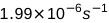 .Find its half-life.
Describe why the very lighter nuclei and very heavy nuclei are unstable. How are they useful as a source of huge amount of energy?
Half-life of krypton is 3.16 minutes. Out of 40 g of krypton, how much will be left after 12.64 minutes?