Your school name
2nd Year Physics Full Book Paper2nd Year · Physics · Punjab (PTB)
Q1. Multiple choice questions (Attempt all · 17 × 1 = 17)
Through which of the AC-circuit elements both emf and current are in phase?
An array of a large number of parallel slits with equal width and equal spacing between centers is called a:
Which medical application of capacitors delivers a life-saving shock to restore a normal heart rhythm?
Quanta is the plural form of:
A motion which repeats itself after an equal interval of time is called a:
Positron Emission Tomography (PET) works through gamma-ray detection and which of the following physical processes?
The potential energy called binding energy is considered to have a value similar to absolute gravitational potential:
An increase in the wavelength of spectral lines from distant stars and galaxies compared to their laboratory values is called:
According to the kinetic theory, gas pressure arises due to particles interacting with each other and what else?
An alternating current (AC) varies sinusoidally and can be represented by time-dependent:
Who constructed the first diffraction grating using fine wires?
The capacitance C of a parallel plate capacitor depends upon:
The current measured in a photoelectric circuit when light shines on the cathode is known as:
The time period of a simple pendulum is directly proportional to the:
Which type of radiation has enough energy to remove electrons from atoms and produce ions?
An atomic mass unit (u) is defined as 1/12th of the mass of an unbound neutral atom of:
What technology uses sensors aboard orbiting spacecraft to monitor Earth's environment from space?
Q2. Short questions (Attempt any 8 of 12 · 8 × 2 = 16)
State the factors on which the time period of a simple pendulum depends and those it is independent of.
Compare the usage of Huygens' principle with Maxwell's equations.
What is the assumption regarding forces of attraction or repulsion between gas particles?
How is the acceleration of the projection point Q related to the centripetal acceleration of the particle?
State the three basic conditions required for two waves to produce a noticeable interference pattern.
Consider a gas enclosed in a sealed container. By what factor does the gas temperature change if: (a) the volume and pressure are both doubled? (b) the volume is halved and the pressure is tripled?
What does the straight horizontal line for Total Energy (T.E.) indicate in the graph?
What does the principle of superposition predict when two identical sound waves arrive exactly in phase?
Define thermal physics.
Define oscillatory motion.
How can constructive and destructive interference be detected in the microwave experiment?
What is the final fate of low and intermediate-mass stars once their nuclear fuel is exhausted?
Q3. Short questions (Attempt any 8 of 12 · 8 × 2 = 16)
If the entire series combination is replaced by a single equivalent capacitor Ce, what will be its charge and potential difference?
Write the formula for the relativistic momentum of a photon in terms of its energy.
Explain how an induction cooktop uses a parallel RLC circuit to heat metal cookware.
Define "Dielectric Constant" or relative permittivity.
Calculate or state the numerical value of the Compton Wavelength for an electron.
Name four real-world devices or fields where mutual inductance finds practical applications.
What is a capacitor and what is its primary function?
When does light behave as a wave and when does it behaves as consisted of particles?
Explain how resistance affects oscillations in an RLC circuit using its mechanical analogy.
How does the electric potential change with an increase in distance from a charge?
Write down Einstein's photoelectric equation and define each of its variables.
Why does a capacitor block DC but allow AC to pass?
Q4. Short questions (Attempt any 6 of 9 · 6 × 2 = 12)
Write the mathematical expression for redshift (Z) and define its components.
What risk is associated with CT-scans, and what is its radiation dose comparable to?
Why can a thin sheet of enriched uranium-235 not sustain a fission chain reaction?
What percentage of the Sun's energy is absorbed by Earth, and what happens to the rest?
What causes an ultrasound wave to reflect when traveling through the body?
What is a moderator, and why is it used?
Why do astronomers need to measure the distances to stars and galaxies?
Why do doctors take special medical precautions before ordering a CT-scan for certain individuals?
What is meant by the random nature of radioactive decay?
Q5. Long questions (Attempt any 3 of 5 · 3 × 8 = 24)
A body is executing S.H.M of amplitude 0.05 m and frequency 10 Hz. Find the value of (i) maximum acceleration (ii) maximum velocity.
Show that temperature of a gas is a direct measure of the average translational K.E. of its molecules.
Two slits spaced 0.450 mm apart are placed 75.0 cm from a screen. What is the distance between the second and third dark lines of the interference pattern on the screen when the slits are illuminated with coherent light with a wavelength of 500 nm?
Explain the phenomena of Pair Production and Annihilation of Matter.
The decay constant of strontium is
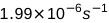 .Find its half-life.