Your school name
2nd Year Physics Second half Book Paper2nd Year · Physics · Punjab (PTB)
Q1. Multiple choice questions (Attempt all · 17 × 1 = 17)
An increase in the wavelength of spectral lines from distant stars and galaxies compared to their laboratory values is called:
Positron Emission Tomography (PET) works through gamma-ray detection and which of the following physical processes?
Quanta is the plural form of:
The potential energy called binding energy is considered to have a value similar to absolute gravitational potential:
What technology uses sensors aboard orbiting spacecraft to monitor Earth's environment from space?
Which type of radiation has enough energy to remove electrons from atoms and produce ions?
The current measured in a photoelectric circuit when light shines on the cathode is known as:
An atomic mass unit (u) is defined as 1/12th of the mass of an unbound neutral atom of:
Which combination of properties makes water the heaviest and most dense?
During a scan inside a CT-scanner, which component dynamically rotates around the patient's body?
If the intensity of the incident light is increased, what happens to the photoelectric current?
To start a fusion reaction by increasing atomic speed, the required temperature is about:
A negative change in wavelength represents a blue shift, which shows that the celestial object is:
The transition of electrons in hydrogen or other light elements results in spectral lines in which regions of the electromagnetic spectrum?
Using uncertainty principle, it can be proved that:
When a heavy nucleus splits into two lighter nuclei, the process is called:
What is the SI unit of radiant flux intensity?
Q2. Short questions (Attempt any 8 of 12 · 8 × 2 = 16)
Why can a thin sheet of enriched uranium-235 not sustain a fission chain reaction?
Write the formula for the relativistic momentum of a photon in terms of its energy.
What is a moderator, and why is it used?
Calculate or state the numerical value of the Compton Wavelength for an electron.
What is meant by the random nature of radioactive decay?
When does light behave as a wave and when does it behaves as consisted of particles?
In what two ways was the discovery of uranium fission different from other nuclear reactions?
Write down Einstein's photoelectric equation and define each of its variables.
What information does the position of a nucleus on the binding energy curve provide?
Name the two fundamental laws of conservation used to solve the Compton scattering equations.
Explain the role of heavy water and sea water specifically at KANUPP.
Will high frequency light has more number of electrons than a low frequency light? Describe briefly.
Q3. Short questions (Attempt any 8 of 12 · 8 × 2 = 16)
Write the mathematical expression for redshift (Z) and define its components.
What risk is associated with CT-scans, and what is its radiation dose comparable to?
What percentage of the Sun's energy is absorbed by Earth, and what happens to the rest?
What causes an ultrasound wave to reflect when traveling through the body?
Why do astronomers need to measure the distances to stars and galaxies?
Why do doctors take special medical precautions before ordering a CT-scan for certain individuals?
Define radiant flux intensity.
Which physical effect enables ultrasound transducers to produce sound waves?
How do ocean currents help in regulating the Earth's climate?
Define attenuation in the context of X-ray imaging.
How can you estimate the radius of a star using Wien's and Stefan-Boltzmann laws?
Define radiation and state its two main uses in medical physics.
Q4. Short questions (Attempt any 6 of 9 · 6 × 2 = 12)
Define a blackbody.
List four common medical physics technologies used in daily life.
How are pair production and annihilation of matter related to each other?
Write down the full form of NIAB and state its location and primary purpose.
State the inverse-square law for radiant flux intensity and explain its significance.
Why are radiowaves and ultrasound preferred for certain types of medical imaging?
An incident X-ray on a metal surface is scattered. What is the wavelength, frequency, energy and speed of the scattered X-ray as compared to incident X-ray?
Write down the chemical equation for the fission reaction of Uranium-235.
How does cosmic redshift support the Big Bang Theory?
Q5. Long questions (Attempt any 3 of 5 · 3 × 8 = 24)
The decay constant of strontium is
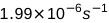 .Find its half-life.
Explain the phenomena of Pair Production and Annihilation of Matter.
According to Hubble's law, the recession velocity of a galaxy is directly proportional to its:
Describe how an ultrasound image is created using the concepts of echoes and reflected sound waves.
Describe why the very lighter nuclei and very heavy nuclei are unstable. How are they useful as a source of huge amount of energy?