Your school name
9th Class Mathematics 3rd Quarter Book Paper9th Class · Mathematics · Punjab (PTB)
Q1. Multiple choice questions (Attempt all · 12 × 1 = 12)
What is the angle formed by two intersecting rays from a vertex in a triangle called?
What is the formula for the weighted mean?
Weighted=

Weighted mean = ?(wx) × Ew
Weighted mean = ?(wx) – S?
Weighted mean = ?(wx) + Ew
In a reciprocal function
 as x approaches zero, what happens to y?
In an equilateral triangle, what is the measure of each angle?
A triangle with all sides and angles equal is called a:
What is the arithmetic mean of the data set: 4, 6, 10, 12, 15, 20, 25, 28, 30?
Which of the following represents an exponential decay function?
y = 2x


What is the condition for two polygons to be similar?
The intersection of the three angle bisectors of a triangle is called:
What is the formula to calculate the size of class limits?
For the function
 , what is the vertex of the parabola?
(0,0)


(1,1)
What is the measure of each interior angle of a regular pentagon?


Q2. Short questions (Attempt any 8 of 12 · 8 × 2 = 16)
Construct the following triangles and find whether there exists any ambiguous case:
 and
 .
A company manufactures school bags. The function of producing x bags is C(x)= 1200 + 800x and the revenue from selling x bags is R(x)=50x. Determine the profit or loss when 250 bags are sold.
A toy manufacturer produces model cars which are similar in every way to the actual cars. If the ratio of the door area of the model to the door area of the car is 1 cm to 2500 cm, find: the ratio of the capacities of their petrol tanks.
The arithmetic mean of 45 numbers is 80. Find their sum.
Construct
 with the given measurements and verify that the perpendicular bisectors of the triangle are concurrent:
 and

How do you identify an exponential function from a table of values?
Find the missing value in the following similar solid:
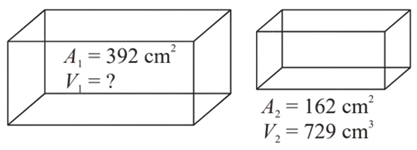
Following are the number of telephone calls made in a week to 30 teachers of high school:
5 8 11 25 13 16 20 17 15 16 30 21 14 18 19 6 22 26 15 19 35 29 31 23 25 20 10 9 7 26 Construct a frequency distribution with number of classes?
What is an ambiguous case in triangle construction?
What is the axis of symmetry of a quadratic function?
Define regular polygon.
Usman rolled a fair dice eight times. Each time their sum was recorded as 8,5,6,6,9,4,3,11. Find the median and mode of the sum.
Q3. Long questions (Attempt any 3 of 4 · 3 × 4 = 12)
A tessellation is created by repeatedly reflecting a basic shape. The basic shape is a right-angled triangle with sides of lengths 3, 4 and 5 units. Find: The minimum number of reflections needed to create a tessellation that covers a square with an area of 3600 square units.
Construct a triangle ABCD with
 and
 . Draw the locus of all points which is: equidistant from A and B. Label the point P inside the rectangle which is 3.1 cm from point A and equidistant from A and B.
The heights (in inches) of 200 students are recorded in the following frequency distribution. Find the mean height of the student by short formula:
Height (x) (in inches) 51 52 53 54 55 56 57 58 59 60 Frequency (f) 2 5 8 24 55 45 38 16 6 1 Plot the graph of the following quadratic and cubic function:
