Your school name
10th Class Biology First half Book Paper10th Class · Biology · Punjab (PTB)
Q1. Multiple choice questions (Attempt all · 12 × 1 = 12)
What is the major dietry cause of kidney stones?
In central Nervous system (CNS) myelinated axons form:
Capillaries are the smallest blood vessels, and their walls are made of only a single layer of cells called ......
Regular handwashing and avoiding contaminated water help prevent:
Nicotine and other chemicals in vapes increase which cardiovascular factors?
In peritoneal dialysis, what acts as the filtering membrane?
Inside cranium, brain is covered by three layers of membranes, collectively called
Coronary Heart Disease (CHD) is the narrowing or blockage of:
Blood vomiting can occur in severe cases of which disorder?
What type of cartilage protects the walls of the trachea from collapsing?
The primary substance reabsorbed in the descending limb of the loop of Henle:
Schwann cells are the supporting cells for neurons. They make:
Q2. Short questions (Attempt any 5 of 8 · 5 × 2 = 10)
Where is the liver found in the human body?
Write the disadvantages of vaping.
Write a brief note on the structure of villi.
What is the role of intercostal muscles during exhalation?
Write down the weight and location of the human liver.
What percentage of all new cancer cases globally does lung cancer account for?
What is the function of the mucus?
Which vessel brings deoxygenated blood from the heart to the lungs?
Q3. Short questions (Attempt any 5 of 8 · 5 × 2 = 10)
Why does oxygenated and deoxygenated blood not mix in the human heart?
How do kidneys conserve water when the body faces a shortage of water?
Explain how the "lubb" and "dubb" sounds of the heart are produced.
How do kidneys help in maintaining homeostasis in the body?
Write a short note on erythrocytes.
What is the renal pelvis?
Which layers are present in veins?
State the two main causes of kidney failure.
Q4. Short questions (Attempt any 5 of 8 · 5 × 2 = 10)
What do you know about synapse and neurotransmitter?
Differentiate medulla oblongata, cerebellum and pons on the basis of their functions
Describe shortly about forebrain.
Differentiate between the following: Cerebrum and Cerebellum
Name the three major parts of the human brain.
How brain is protected?
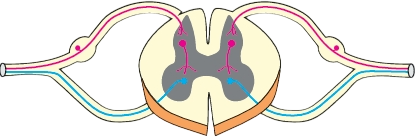
Identify the following diagram, and locate the white matter, grey matter, three types of neuron, and ganglia.
What are Schwann Cells and what is their role?
Q5. Long questions (Attempt any 2 of 3 · 2 × 9 = 18)
What are the possible causes of lung cancer? Explain the harmful effects of smoking apart from lung cancer.
Why is it important to maintain a healthy balance of gut bacteria?
What is meant by platelets? Describe their functions.