Your school name
10th Class Biology Second half Book Paper10th Class · Biology · Punjab (PTB)
Q1. Multiple choice questions (Attempt all · 12 × 1 = 12)
If farmers mostly grow GM crops, traditional and naturally diverse varieties might become ......
What is the function of a crosome?
The mode of transmission for Escherichia coli is:
Which nitrogenous base is found in RNA instead of the thymine found in DNA?
In the beetle example, why are brown beetles more likely to survive than green beetles?
In genetic engineering, "recombinant DNA" means:
Following are the parts of male reproductive system except:
Lyme disease is transmitted to humans through the bite of:
The overall flow of genetic information from DNA to RNA to protein is known as the ......
Which of the following is a vestigial organ in humans?
Yeast plays a crucial role in:
Follicles in the ovary contain which type of cells?
Q2. Short questions (Attempt any 5 of 8 · 5 × 2 = 10)
What is the role of FSH in males?
Differentiate between a Chromatid and a Centromere.
Complete the chart of oogenesis by mentioning the names of cells and number of chromosomes (2n or 1n).
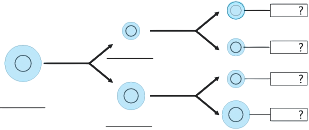
Define monohybrid cross and a dihybrid cross and give an example of each.
Which organ secretes GnRH?
What will be genotype of plants produced as a result of cross between two plants having Genotype Rr?
Why are HIV cases rising in Pakistan?
Write down the key differences between DNA and RNA.
Q3. Short questions (Attempt any 5 of 8 · 5 × 2 = 10)
How many basic types of diseases are there? Name them.
Discuss the role of yeast in making bread.
Define the term 'Allergy'.
Why are bacteria essential microorganisms in biotechnology?
How do humans contract Aspergillosis?
Give examples of diseases that scientists are researching to cure using gene editing.
Write a note yellow fever.
What are the main health concerns related to Genetically Modified (GM) foods?
Q4. Short questions (Attempt any 5 of 8 · 5 × 2 = 10)
Why palaeontologists study fossils?
Which are the main sources of variations?
Explain how the food sources on the Galapagos Islands affected the finches.
What is species?
How do variations lead to gradual evolution over time?
What is comparative anatomy?
What are the two types of speciation?
Explain Allopatric Speciation with an example.
Q5. Long questions (Attempt any 2 of 3 · 2 × 9 = 18)
Write some important applications of industrial biotechnology.
What is meant by sexually transmitted diseases? Explain.
What is genotype? Describe its types.