Your school name
1st Year Physics 4th Quarter Book Paper1st Year · Physics · Punjab (PTB)
Q1. Multiple choice questions (Attempt all · 12 × 1 = 12)
A frame of reference that is accelerating w.r.t. an inertial frame is called:
The anti-particle of electron is:
If fingers of right hand show the direction of magnetic field and palm shows the direction of force, then thumb points for:
The concept of space-time combines:
Which one of the following is the fundamental particle?
Which force balance the magnetic attraction to prevent ferrofluids from settling?
If an observer is moving in the same direction as a sound wave, the velocity of the wave seems to be:
Which one of the following radiation/particles has the highest ionization power?
A current flowing towards the reader be denoted by:
In relative motion, if object A is stationary and object B is moving, the velocity of B relative to A is:
Which type of particle naturally appears in string theory, helping it include gravity?
Lenz's law is related to the:


Q2. Short questions (Attempt any 8 of 12 · 8 × 2 = 16)
Is it possible to change both the area of the loop and the magnetic field passing through the loop and still not have an induced emf in the loop? Give reason.
What are the two postulates of special theory of relativity?
What is the effect of beta plus decay on the nucleus?
How does Lenz' law obey the law of conservation of energy?
Can an object with mass travel at the speed of light?
State the role of Higgs Boson in the generation of mass in modern physics theories.
At a given instant, a proton moves in the position x-direction in a region where there is magnetic field in the negative z-irection. What is the direction of the magnetiv force? Wil the proton continue to move in the positive z-direction? Explain.
What is a relative motion?
Is radioactivity affected by temperature or pressure?
A plane conducting loop is located in a uniform magnetic field that is directed along x-axis. For what orientation of the loop is the flux a maximum? For orientation is the flux a minimum?
Does theory of relativity contradicts Newton's laws of motion? Explain briefly.
Fill in the missing particle or nucleus:(a)
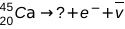 (b)

Q3. Long questions (Attempt any 3 of 4 · 3 × 4 = 12)
Explain how ferrofluids work?
What is relative motion? How does it differ from absolute motion? Explain.
Describe four fundamental forces in nature.
Electrons are accelerated from rest through a potential difference of 15 kV in an oscilloscope. The electrons then pass through a 0.35 T magnetic field that deflects them to the desired position on the screen. Find the magnitude of the maximum force that an electron can experience.