Your school name
2nd Year Business Statistics Second half Book Paper2nd Year · Business Statistics · Punjab (PTB)
Q1. Multiple choice questions (Attempt all · 15 × 1 = 15)
A set which conatin countless elements is called:
The ratio obtained by dividing the price in a given year by the price in proceeding year are called:
If
 then A and B are:
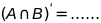


None of these
Index numbers are basically classified into:
The probability of getting head on a single throw of a coin is:


None of these

Index number for base year period is always:
The set of all possible outcomes of a random experiment is called:
An ordinary arrangement of object is called:
If laspeyre's index = 116 and Passche's index = 110. Then Fisher's index is equal to:
If
 then events A and B are:
A set, which conatins no element is called:
If lespeyre price index number is 200, Passche's price index number is 200, then Fisher price index number is:
The probability of an event must be:




Q2. Short questions (Attempt any 10 of 15 · 10 × 2 = 20)
Define quantity index number.
Define exhaustive events.
What is meant by universal set?
Given
 then find current year a weighted index number.
What is the range of probability.
Define set.
Why index numbers are called economic barometers.
Define dependent events.
How many committee of 4 persons can be taken from 12 persons?
Give that
 . Find Laspeyre's price index number.
Write a sample space for toss of fair cubical die.
Differentiate between permutation and combinations.
Explain the differnce between simple and composite index number.
Distinguish between sure event and impossible event.
Define combination.
Q3. Long questions (Attempt any 3 of 5 · 3 × 5 = 15)
One integer is chosen at random from the numbers 51, 52, 53 ...... 100. What is the probability that the number chosen is divisible by (i) 10 (ii) 6?
The price of wheat (per 40 kg) is given below. compute chain indicies using 1999 as base year:
Years 1999 2000 2001 2002 2003 2004 2005 Price 550 550 600 640 690 750 800 Let A={1,2,3,4}, B={2,4,6,8} and C={3,4,5,6} Find:(i)
 (ii)
 (iii)
 (iv)

A die is rolled. What is the probability that it shows: (i) Odd numbers (ii) Even numbers
From the following data. take 1953 as base and compute:
Price Quantity Item 1953 1963 1953 1963 A 10 12 120 100 B 8 10 150 130 C 12 13 80 70 D 15 20 60 50