Your school name
1st Year Chemistry Chapter 3 Test1st Year · Chemistry · Punjab (PTB)
Q1. Multiple choice questions (Attempt all · 10 × 1 = 10)
London dispersion forces increase with:
In VSEPR, lone pair-lone pair repulsion is:
Species has the highest bond order is:
Molecular orbitals are formed by:
Species has a bent molecular shape is:
The shape of
 according to the VSEPR model is:
Molecule requires the use of a double bond in its Lewis structure is:
Molecules has nonpolar covalent bonds is:
Which of the following species contains a dative bond?
In sp3 hybridization, the bond angle is:
Q2. Short questions (Attempt any 6 of 8 · 6 × 2 = 12)
Sketch the hybrid orbital and bond formation in PCI3, SiCI4, and NH4+.
Draw the Lewis (electron dot) structures for the following species: (i) HCN (ii)
 3
Write the molecular orbital configuration for C2.
Draw the Lewis structures and tell whether the following ions involve expanded octets.
(i)
 ii)

Differentiate between dipole-dipole and hydrogen bonding.
Compare melting points of ionic and metallic solids.
Why is the bond angle in NH3 less than in CH4?
The structure of propanone (acetone) is:
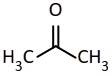 (ii) Can propanone make a hydrogen bond with water when both are intermixed?
Q3. Long questions (Attempt any 2 of 3 · 2 × 4 = 8)
Discuss the formation of F2 molecule in the light of Lewis concept, VBT, and MOT.
Draw the molecular orbital diagrams of the following molecules. Calculate their bond orders. (i) H2 (ii) He2 (iii) N2 (iv) O2
What are the postulates of VSEPR model? Discuss the structures of the following species with reference to this theory. (i) CH4 (ii) NH3 (iii) H3O+ (iv) PCl5 (v) SO2 (vi) SF6