Your school name
1st Year Chemistry Chapter 4 Test1st Year · Chemistry · Punjab (PTB)
Q1. Multiple choice questions (Attempt all · 10 × 1 = 10)
True about theoretical yield is:
Which of the following gases will occupy the same volume at STP if the masses are equal?
Equation of water formation is given as:
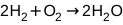 moles of hydrogen involve:
Methane reacts with steam to form hydrogen and carbon monoxide; what volume of hydrogen gas can be obtained from 100cm³ of methane at STP:

27g of A
 will react completely with how much mass of O2 to produce
 :
Indicate the incorrect statement from the following:
At STP, which gas has the highest density?
Equal volume of CO and N2 are taken in identical condition, the correct relationship between masses of two gases is:
When preparing a dosage form, why is it essential to use stoichiometry in the synthesis of active ingredients?
The reactant that is left behind at the end of the reaction is called:
Q2. Short questions (Attempt any 6 of 8 · 6 × 2 = 12)
Why do ionic compounds not possess molecular formulas?
Calculate the mass in grams of 2.74 moles of KMnO4.
Why does dilution decrease molarity but not the number of moles of solute?
Calculate the number of moles of O, N, and Mg atoms in 9 g of Mg (NO3)2
Which laws are to be considered during stoichiometric calculations?
Calculate the mass in grams of 10-3 moles of water.
Explain why adding more water to a solution dosn't change its mass of solute.
Explain why lighter gases diffuse faster but can still have high density under certain conditions.
Q3. Long questions (Attempt any 2 of 3 · 2 × 4 = 8)
A solution of sodium hydroxide (NaOH) is prepared by dissolving 2.00 g of solid sodium hydroxide in water to make a final volume of 250 cm3. (i) Determine the molar mass of sodium hydroxide.(ii)Calculate the number of moles of sodium hydroxide used.(iii) Calculate the concentration of the sodium hydroxide solution in mol dm-3.(iv)If more water is added to the above solution to raise the volume of solution to 500 cm3, what would be the concentration now?
Differentiate actual and theoretical yields. Why the theoretical yield is always greater than actual yield?
When iron(iii) oxide (Fe2 O3) reacts with carbon monoxide (CO) in a blast furnace, iron metal (Fe) is produced according to the following equation:
 If 1.00 kg of iron(iii) oxide is reacted with excess carbon monoxide, and 650 g of iron is obtained, what is the percentage yield of iron?(Ar of O = 16.0, Fe = 55.8)