Your school name
2nd Year Mathematics Chapter 4 Test2nd Year · Mathematics · Punjab (PTB)
Q1. Multiple choice questions (Attempt all · 10 × 1 = 10)
If y=cx-1. then its corresponding differential equation is:
x
 =1+y
- =x+y
x
=y-1- =cy
Inflation in economics means that the price of goods is:
The differential equation
=ex-y is:A differential equation of degree 1 is specifically called a:
Which law states that the sum of voltages across the resistor and capacitor is equal to the total battery voltage?
If a differential equation cannot be written as a polynomial in derivatives, its degree is:
The degree of a differential equation is the greatest exponent of the:
The term "differential equation" was introduced by Leibniz in which year?
Which of the following is a homogeneous differential equation?
The general solution of the differential equation y dx + x dy=0 represents a family of:
Q2. Short questions (Attempt any 6 of 8 · 6 × 2 = 12)
Write the order and degree (if ddefined) of the following differential equation:
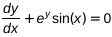
Solve the initial value problem:

A cup of coffee is served at
 in a room where the temperature is
 . After 10 minutes the coffee cools to
 . Find the temperature of the coffee after 20 minutes.
A radioactive isotopes has a half-life of 12 hours. The initial mass is 160 grams. How much mass will remain after 36 hours?
Find the general solution of the differential equation:

Name any three real-life situations that can be modeled using first-order differential equations.
When and why is an arbitrary constant introduced during the process of solving a differential equation?
In a culture, there are 100 bacteria initially and are doubled and are doubled in 2 hours. Find the number of bacteria 7 hours later.