Your school name
2nd Year Mathematics 2nd Quarter Book Paper2nd Year · Mathematics · Punjab (PTB)
Q1. Multiple choice questions (Attempt all · 12 × 1 = 12)
The separate linear equations for the pair of lines
 are:
If y=cx-1. then its corresponding differential equation is:
x
 =1+y
- =x+y
x
=y-1- =cy
During the derivation of the standard equation of a horizontal ellipse, what is the defined algebraic relationship between constants a,b and c?
The point where all three medians of a triangle intersect each other is called the:
Inflation in economics means that the price of goods is:
According to Kepler's first law, the orbits of the planets in the solar system follow which geometric shape?
Who first developed analytical geometry in the 17th century?
The differential equation
=ex-y is:For the elliptical flower bed with a major axis of 10 m and minor axis of 6 m, what is its semi-major axis (a) and semi-minor axis (b)?
In a triangle PQR with vertices P(1, 2), Q(5, -6), and R(7, -2), what are the coordinates of the midpoint of side QR through which the median from P passes?
A differential equation of degree 1 is specifically called a:
A line that is perpendicular to a tangent line at its exact point of contact is defined as the:
Q2. Short questions (Attempt any 8 of 12 · 8 × 2 = 16)
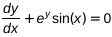
Write the order and degree (if ddefined) of the following differential equation:
Find the equations of the circles passing through the points A(3,4) and B(3,-4) and touching the line x+2y+9=0.
Define analytical geometry.
Solve the initial value problem:

An ellipse has the following properties: The centre is at the point (3,-2). Find the standard equation of this ellipse.
Write down an equation of the straight line which cuts the x-axis at (3,0) and y-axis (0,-6).
A cup of coffee is served at
 in a room where the temperature is
 . After 10 minutes the coffee cools to
 . Find the temperature of the coffee after 20 minutes.
Find the equations of the tangent and normal to the circles:
 .
Write the practical applications of analytical geometry.
A radioactive isotopes has a half-life of 12 hours. The initial mass is 160 grams. How much mass will remain after 36 hours?
A landscaper wants to create an elliptical flower bed with a major axis of 10 meters and a minor axis of 6 meters. Using the gardener's method, two stakes are placed at the foci, and a loop of string is stretched around them to trace the ellipse: (a) How far apart should the two stakes be placed? (b) What should be the total length of the string loop?
Triangle ABC has vertices A(2,3), B(4,5) and C(-2,7). Find the equations of medians of the triangle ABC.