Your school name
2nd Year Mathematics 4th Quarter Book Paper2nd Year · Mathematics · Punjab (PTB)
Q1. Multiple choice questions (Attempt all · 12 × 1 = 12)
What additional insight does the graphical method provide?
A scalar function assigns a ...... to each point in its domain.
What do the x-coordinates of the intersection points give?
Vector-valued functions are useful in:
If one period is added repeatedly to a solution, we obtain:
Vector-valued functions can be used to model:
What does the graphical solution of a trigonometric equation involve?
Which of the following mathematical functions is classified as a scalar function?
An unknown value of an angle that satisfies a trigonometric equation is called:
The derivative of a vector-valued function provides the instantaneous:
Which coordinate of an intersection point represents the solution to f(x)=g(x)?
In the satellite example, the x-coordinate is:
Q2. Short questions (Attempt any 8 of 12 · 8 × 2 = 16)
Find the Find the domain and range of the following vector-valued functions:
A radio tower stands on flat ground with a small antenna mounted at its top. From a point 50 meters away from the base of the tower. The antenna subtends the same angle as a 1 meter vertical rod placed at the base of the tower. The total height of the tower and antenna is 10 meters.
(a) Find the height of the tower (without the antenna).
(b) Calculate the subtended angle.
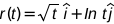
Given
 , construct r(t).
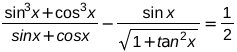
Solve the following trigonometric eqautions:

Find the first-order derivatives of the following vector-valued functions with respect to t.

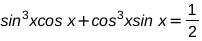
Solve the following trigonometric eqautions:
A Ferris wheel of radius 20 m rotates with an angular speed of 0.2 rad/sec.
(a) Construct its position vector r(t)
(b) Find the passenger's velocity at t =10sec
(c) Show that the acceleration is centripetal (toward the center)A projectile is launched from the ground with an initial velocity
 30m/s. The range R of the projectile is given by the formula
 , where
 is the launch angle to the horizontal
 is the acceleration due to gravity.
(a) Find the angle
(in degrees) required for the projectile to hit a target exactly 80 meters away.(b) If the maximum range achievable is
 determine the angle & that gives the maximum range. Justify your answer mathematically.
Find the first-order derivatives of the following vector-valued functions with respect to t.

Solve the equation
 graphically over the interval
 .
A quarterback throws a football with a position vector
 .
(a) Find the time of flight before it hits the ground.
(b) What is the maximum height reached?
(c) At which time did football reach its maximum height?Solve the following trigonometric equations: